
November 2026 update. The operating-system idea in this post is still useful to me, but a system needs named owners, not just a task board. The ANTNINJA project examples below are historical; that project is no longer active. For each change I want to know who requested it, who can approve it, what evidence would show it worked, and who responds if it breaks. That is especially important when several agents can prepare code or content at once.
An agent can draft, inspect, and test. It cannot silently turn its own plausible report into a production decision. I keep the original goals-and-accountability discussion below and add this rule to it: a clear handoff and a recoverable release are part of the work, not paperwork after the work.
Before I explain the mechanics of how to create an effective working system to run a startup, do any of the following questions resonate with you?
1.You feel you are a bit disorganised, well extremely disorganised and need to have a more structured way of working?
2.You think your goals are not aligned and you seem to work on something at the spur of the moment?
3.You don’t even know what you are doing, just copy pasting and executing on ideas randomly on what you read and learn?
4.You keep getting information but somehow feel you do not apply it effectively?
5.You think your product sucks but there is hope someone might use it, someday? OR
6.Your gut says your product meets market demands but you can’t sell it because the software or your blog sucks?
7.You feel you will lose customers if you do not know how to communicate with them properly?
8.You think your communication model with your team or customer is haywire?
9.You think you need to have some structure in place but don’t know what structure to put in place?
10.You feel this is a hobby project more than a grand vision of creating a company?
11.Or, you think, this blog or software program is not going to give you any money, why even bother?
12.You want a clearer way to see what you committed to and what is still unfinished.
13.You feel slow, even when you are putting in the hours.
Well…… I feel the same way, but I can tell you honestly, there are many companies or start-ups out there that would have the same questions. I wrote this to show the system I was trying, not to promise one structure that would fix every startup.
I drew this from books, courses, and a few months of trying the ideas in my own work. It is a record of that experiment, not a required operating model for every company. This requires both a mind shift change and a behavioural change.
You can challenge the points in this blog and you can even tell me this is total bullshit with strong reasons. In fact, you can even dare to tell me you do not like certain parts of this blog. I will accept all of it, but I will also need a replacement strategy. This is just a start and this blog is designed for continuous upgrades to make the ways of working ruthlessly effective, which in my terms, give customers something useful and build a business that can sustain the work. We all know this won’t be achieved without effective hard work. So, take a 2minute break, grab a snack to eat and when you are back let us get started.
So you are back or this blog is so engaging that you could not stop to take a break? Either way you might be asking, well Anthony, what the hell is this blog all about? How suddenly did you find the solution to all the billion problems every blogger or programmer has? My surname is SHIVA which is “the supreme being who creates, protects and transforms the universe”. Go check Wikipedia for more information. Do that later, for now, let me give a brief overview of what this blog entails.
1st, I talk about the mindset that you need to inculcate. Then about creating your strategic objective, your operating principles and finally about your working procedure. If all these terminologies sound alien to you, it will become clear as you read the document.
So what mindset are we supposed to have, Mr. SHIVA?
A System Mindset.
My understanding of a system mindset: There are no opinions, gossip or what you feel or think. I really don’t care what you feel or think. What I do know is, buying is a science, selling is a science, rockets flying is a science and so is the way your human body works a science. Newton’s laws work in Canada, will work in the slums of Mumbai and even on damn Jupiter.
Let me explain in a more mathematical way.
Newton’s 2nd law: Force = Mass X Acceleration ==== SCIENCE
Your opinion is equivalent to Force = Goat X Sheep ==== BULLSHIT
We try to get a particular output using some random variables because we have an opinion about it. Most of the time your opinion is BULLSHIT. We do not realise it, but that is how we expect things to work and when they don’t, we wonder why. Well, now you know why your variables don’t even make sense.
So if Business = Making money X giving great value to customers
Don’t tell me Business = Charity X losing money X learning X trial and error.
The universe has very strong laws and principles. We are not going to defy it because it will NEVER work. You cannot have anything flying without wings and Newton's 3rd law of motion. The universe demands that in order to fly you need to obey its laws. Whether you are a bird, a helicopter, a drone or a rocket. You need wings to fly. Don’t defy it or you will crash.
Similarly, in business, there are laws and rules. You just need to blindly obey them and I do not see why you won’t be successful.
The universe has a set of rules/laws, which in combination creates very powerful systems. If you can’t think of one system then think of your own damn bloody body. It is created by nature and arguably the most complex system you know. You defy it you die. Stop breathing for 3 minutes and see what happens? Your body will trigger a defence mechanism – in the form of extreme pain extra strength it finds from your reserves. You will do whatever it takes to survive because the universe has designed our system this way. These principles are universal to a bacteria to a cow and to humans. It’s universal. Got the idea?
A system approach is to find what works by constant testing and iteration based on real life experiments or from formulas designed by successful experts. For e.g. Newton is an expert in mathematics and physics (though he is dead, to me he is still alive through his formulas, hence “is”). If we take his formula blindly it should work under all circumstances. He has done the experiments and we are lucky that it works even without understanding it. Similarly, if someone successful in business tells you this works, you must use the formulas without bias. So Let us work the system.
IS THIS CLEAR that you now need to have a system mindset? GOOD!!!
Next time someone recommends a valuable video or tells you to read a book, or you tell me to read something from an expert, you should be obliged to READ IT. The variables for success are in those books and videos, and you should be hungry to find your formula.
Now that you have the right mindset, let us continue to define your Strategic Objective.
Strategic objective
What is the bloody heck this strategic objective, Mr Shiva? Let us take living creatures with skeletons as an example. The skeletons help to form a functioning structure for that particular creature. It gives dimension and form. Based on the skeleton formation, the creature can be designed to run fast like a cheetah, swim in water like a shark, grip things like human fingers, have long arms to swing from tree to tree like a monkey, constrict its prey to death by suffocation like snakes. Whatever the species be, the skeleton formation is the basis in what their survival functions are.
Ok Mr Shiva! I got that. But how does this apply to making a blog or software company?
Similar to living creatures with skeletons, strategic objective gives you a skeleton on how you can perform your functions smoothly and survive with ease. It is a layout, a framework a strategy. It helps you to look at your business from the outside, see how it looks, see how it functions and help you make better judgments on how you or your team is working rather than what exactly you are working on.
What the hell, I still don’t bloody understand this strategic objective?
Good!! My mum would call me dodo if I kept saying “I still don’t understand what you are saying”. Here we play no name calling, so unlike my mom, I will try to explain using visual aids and an actual structure we are going to follow.
Trivia: A Dodo is an extinct bird. Today it is used in sentences to call someone dumb.
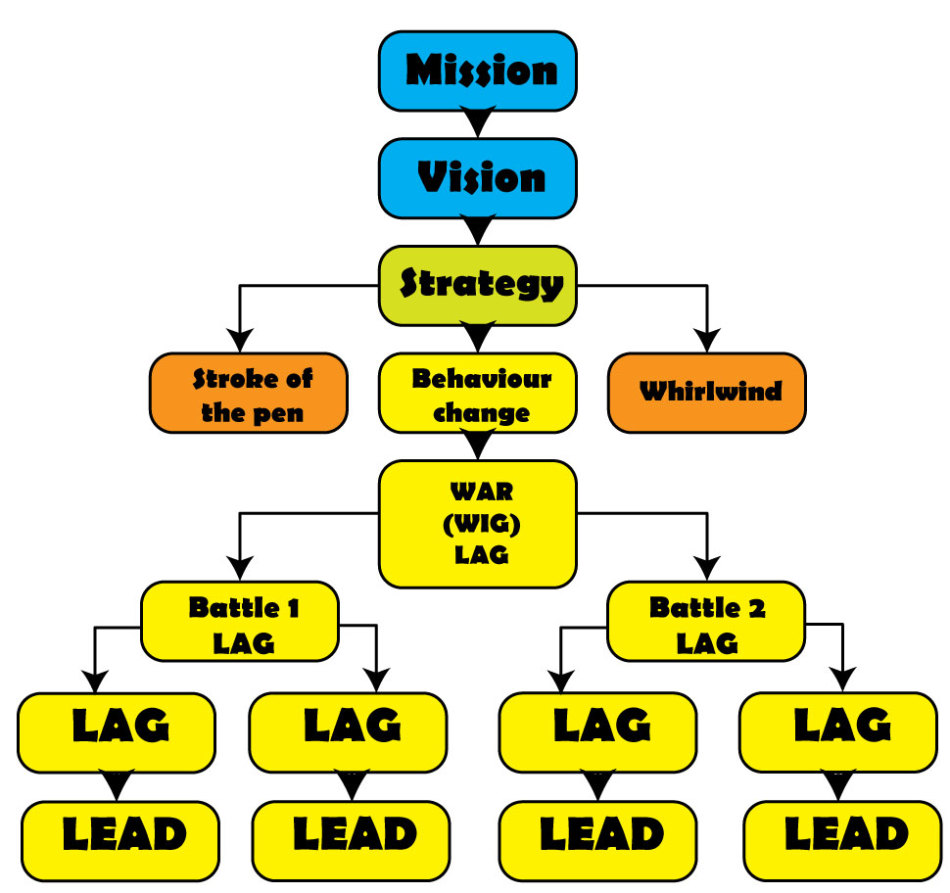
Go check figure 1 below. Stare at it for 5 seconds and come back. Mr SHIVA!!! You are supposed to make it easier, now you have complicated this whole damn thing. Relax, sip some coffee or water and let me explain to you. This is very important and the foundation of this whole document is based on this framework. This is taken from the book 4-Disciplines of Execution.
The core framework is based on the yellow boxes.
Let say we are an army from country Bubumo (A), and we are going to attack a country called ZappakaMamaka (B). Pronounce the words loud. You are from Bubumo. You are going to attack ZappakaMamaka. Please do not look these countries up. You will only be able to find it Shiva’s database of knowledge. Your goal is to conquer ZappakaMamaka (B).
LAG1 -High-level goal: Conquer ZappakaMamaka by June 2017-> War is won
LAG2 -Lower level goal: Conquer capital city of ZappakaMamaka by April 2017-> Battle 1 won
LAG3 -Lower level goal: Conquer next major city of ZappakaMamaka by May 2017 -> Battle 2 won
What I described above is called a WIG. Widely important goals.
WIG – Widely important goals are goals defined that help you to reach your success target.
STEP1 – Define your WIG and your LAG measure
LAG - Measuring WIG is called LAG measure. Have a very specific outcome and must be accomplished on a specific date/time. Does this make sense?
In your case, a LAG measure could get 200 email subscribers by end of March. To accomplish this you can have a sub-LAG measure, like create 3 blog post with 3000 words or more. Those two too can have sub LAG measure and so on.
Getting back to our example of Bubumo attacking ZappakaMamaka, just because you have your main goals does it mean you will win the war? What if you have soldiers that are dim wits, they can barely hold a damn gun or you have supreme talented soldiers but for the sake of God cannot work as a team?
STEP2: Define your LEAD Measure
Welcome to LEAD measures. LEAD measures are not logical measure but behavioural measures. In this battlefield example LEAD measure could be:
Soldier much have impeccable communication skills using radio
Soldier must have the ability to handle AK-47 and have accuracy of 90% at target
Soldier must have intense flying experience and must be able to fly between buildings
Soldier must be able to have the physical capacity of being awake for 7 days straight without food or water.
Do these variables sounds like a team that can actually win? I am not a General but you get the point. They are not logical measures but behavioural measure. How does this apply to ANTNINJA?
In this historical ANTNINJA example, I set a goal of three posts and 200 email subscribers by the end of March. What writing habits might help me work toward it? For example:
Work 2 hours every day on writing without any distraction to accomplish 1000 words
Work 8 hours a week on learning copywriting, write engaging articles and practise writing 1000 words
Work 12 hours a week on programming, make the blog platform more stable and usable and test to see if it works as desired ( this is particularly for me, but you get the point)
These are LEAD measures. If you put the time and you are productive, you see how you would be getting one step closer to your final goal and finally accomplishing your LAG measure.
Think LAG as LOGICAL MEASURE
Think LEAD as EMOTIONAL or BEHAVIOURAL MEASURE
Step 3: Keep a Compelling Scorecard
Gamify the process. We love to watch FIFA or for that matter any sport of your choice. We watch it for one reason only. THERE IS A SCORECARD. Without a scorecard the excitement would not be there. Measure your LEAD effort. Keep it creative and measure it using your own scoring system.
You can create your own point system. It can be unique to you.
For e.g. If you do 1 hour of research you can call it 1 point
If you do 1 hour of learning and practising you can call it 2 points
If you do 1 hour of distraction-free writing you can call it 3 points
If you accomplish 6 unique points then you get so much work done. You need to execute all three activities. You can’t just research for 6 hours and say you have 6 points. Use common sense. Your research alone is not producing any output. And if no output you won’t be getting closer to your LAG measure.
This way, to complete your LAG measure you can calculate how many points you need to accumulate. Be creative!!
Step 4: Cadence of Accountability
Getting back to our war example. One week has passed and our plan to capture ZappakaMamaka (B) is not going smoothly. Our soldiers are getting injured and somehow we are a week behind in accomplishing our goal. Should we continue doing what we have been doing or should we evaluate what is going wrong?
What gets measured gets accomplished. Every week we have to know where we are, where we need to be and make adjustments to our LAG and LEAD measure. Find the parts of the mechanics that are not working and see how we can improve its performance. For our Bubumo soldiers, we supplied them with enough ammunition but very little protective gear. This could be 1 reason our soldiers are getting injured too quickly. Or, we are attacking a very strong ZappakaMamaka city, and as a result, our strategy is not working as planned. We need more Fighter jets or more pilots. Whatever be the case, we can make adjustments to our plan because we are measuring it.
You as a blogger or a programmer, you can create a weekly report stating what work you were supposed to get done and what you actually got done. You can brainstorm and find ideas on how to improve your effectiveness. This way you can keep yourself accountable.
Can you now see how all of this is working towards a very powerful system?
So let us recap.
LAG Measure (WAR) -> State what you want to accomplish exactly and by when.
LAG Measure (Battle) -> State what you want to accomplish exactly and when to get one step closer to winning the war.
LEAD Measure -> what behaviour you need to change to accomplish your lag measure?
Learn to work on a task uninterrupted for 2-3 hours
Learn to research and learn new skills quickly
Speed of implementation. As soon as you learn something, apply it instantly.
Keep a compelling scorecard -> Gamify your behaviours
Give points to any activity that will help you accomplish your lead measure which in turn will help accomplish your LAG measure
Cadence of accountability -> what gets measured get accomplished
Every week, evaluate how you performed. Send an email to the team and ask for inputs on how to make your efforts more effective.
Next, let us define your operating principles.
Operating Principles
Oh Mr. Shiva, What is this now!! You are now acting too smart with all these fancy words. Well, maybe, but bear with me. In Strategic objective we designed the skeleton, in this part we will be installing the organs and placing them in the right location to make the creature come to life.
Go take a break. I will wait here!!
Now that we have our skeleton in place, how are we going to define our LAG measure? What will be our widely important goals?
You might say – 200 email subscriber by end of March
I say 2000$ by end of March.
Or you might say, 5 guest bloggers by end of March
I might still say, 2000$ by end of March
(You can have these conflicts in your own head)
As you can see we can quickly get into an argument and as a result not know what war are you really fighting? This is where operating principles can help resolve conflicts, define your LAG measures and start to get working.
To help with this, we have to define a set of questions
What was the mission of the ANTNINJA blog at the time? I wrote:
The purpose of ANTNINJA is to be the greatest resource hub for bloggers where they learn behaviours, strategies, technologies and tactics to help them earn money from their blogs.
Who is, your target audience?
Professional experts In the field of medicine, engineering, travellers, pharmaceutical who have a blog or are starting to have a blog and need help on how to make money.
What is your core message or the articles you need write?
To write a blog post related to metrics and analytics. Every blog must have a component on how metrics and analytics can help our readers make better decisions.
What is your business objective?
To write blog post designed to make conversions
What are conversions?
Email subscription, comments, buying antsand service or any product we sell
What topics do your articles entail?
Business, self-development, marketing, programming, learning, analytics, blogging, copywriting.
How are you going to engage your audience?
Writing long blog post
Doing video blog
Doing podcast
Interviewing people
Having engaging and interactive blogs – VR, interactive graphics, infographics, data visualisation
Your business impact?
Our readers must read our articles and get golden nuggets which will help them to make a profitable blogging business.
What marketing strategy are you going to leverage based on your blog business?
1.Social media: Facebook (organic and paid)
Medium
2.Comment on other blogs related to what we are working on
3.Write guest blogs on other influential blogs
How to define you main LAG (WAR) measure?
Make 10000$ by the end of March
How to define your sub-LAG (battles) measure?
Write blog post that is relevant to your business objective
How to define your LEAD measures?
What can be your benchmark?
What results do you expect in the 1st, 2nd and 3rd quarter?
What should be the unit to measure my cadence of accountability?
How should I keep myself accountable?
As you can see, the above is a series of questions. Operating principles are a set of guidelines to help you write clear goals that match the mission of your blog company. Once it is defined you can get to work on what you need to focus on and what you do not.
Think, operating principles document like the rudder of the ship. It sets the direction where you need to go. There can be grey areas where you are not sure what you need to work on. This gives you principles or guidelines to decision-making.
Finally, we get to working Procedures
Working Procedures
What is this??? Working procedures are a set of rules that we must comply to accomplish a given task. These are guidelines so that we are not confused what needs to be done.
You may have questions like
What should I blog on?
How should I research on what to blog on?
How should I interact with the customers?
How to deal with internal conflicts?
How to deal with customers?
A simple checklist for researching on what to blog on:
1.Who are you exactly writing to?
2.What problem or frustration this person has?
3.What will the magic bullet solution look like?
4.What proof does this magic bullet work?
5.How relatable is this solution?
6.What objections? Can you answer all the objections?
7.What is the call to action?
A simple checklist for writing a blog:
1.What headline can grab the attention of this one person I am addressing this blog to?
a.What exactly is the core pain point, and how am I solving it?
2.How can I make this person like me and my blog?
3.How can I prove to be an authority?
4.How can I generate or give value to this person to activate the reciprocity switch?
5.How can I build proof, what I am saying is correct?
6.How can I build the credibility of my blog article?
7.How can I make my readers trust me?
8.If they follow the advice in this article, will they feel safe?
9.Are my readers making the best choice when they read and take action on my articles?
Conclusion:
You need to accomplish your targets, meet your deadlines and start to make money. And for this reason, this blog is created. It is not written in stone, I will refine and update this blogs based on your feedbacks to make it even more effective.
Lastly, are you satisfied working for someone else? Do you want to keep doing the things you have always been doing? I wanted to create something useful and have more control over how I worked. That is still the reason I care about a repeatable system. Define a game plan that will help you start to make money and live a life of freedom as quickly as possible.
Resources:
These principles and structure have come about after reading and researching a lot on leadership, game plan and discipline. Taking all the knowledge from these books has helped me write this document with a clear focus. I highly recommend you too should read them.
Books to read:
1.Work the system – Sam Carpenter
2.4dx – 4 Disciplines of Execution
3.Checklist manifest – Atul Gawande
5. Marriot case study of using the 4Dx.
Post your comments below.