
November 2026 update. This long guide began with the problem of writing blogs people can find. The publishing problem I work on now has another layer: one authored article may be selected for a particular site, rendered with that site's design, and updated without treating reader accounts or comments as disposable build output. The source article, its byline, images, and destination links need clear ownership throughout that path.
I still care whether a reader can find a post, but I do not treat a ranking estimate as an outcome. I check the delivered page, its links and media, the signup path, and what happened after publication. Read the original guide for the writing process; treat its dated search claims as historical advice, not a current guarantee.
A
re you looking to start blogging, but frustrated that hardly anyone reads what you publish? Maybe you have written something you are proud of and still cannot find it in search. I know that feeling. This guide is about figuring out whom you are writing for, what they need, and how to make a piece worth reading. I cannot promise you a thousand visitors or a first-page result. I can show you the questions and habits that helped me write with more purpose.
Whether you are a seasoned blogger, a beginner or anywhere in between, there is something for everyone in this post.
Who is this long-form blog for?
Before describing what this long-form blog is all about, I would first like to focus on what this blog post is not. This post is not for those seeking help in creating a WordPress site or setting up your blogging platforms. We are not going to go into the technicalities of how to set up a blog. There are numerous tutorials out there that will do a much better job explaining how to set up your blog. This is also not a post on SEO and how to trick search engines to rank your website high. Such tactics rarely work so stop looking for quick hacks.
This post is about why, how, and what to publish. What makes a piece worth a reader's time? What kinds of articles can you write, and how do you get one finished? It is a long guide, so take your time, bookmark it if it helps, and let's get started.
A little housekeeping: I sometimes use post, blog, and article interchangeably. By traffic I mean people arriving at a page, not a number worth chasing for its own sake.
Introduction
When I first started blogging, I sucked. Some of those old posts are still here, and I keep them because there is no overnight-success formula. I wrote for the sake of writing, then gradually learned that writing is a skill I could practice. Reading copywriters such as Gary Halbert, Joseph Sugarman, Claude Hopkins, and John Carlton taught me to pay attention to the reader's next question. Writing is not only about selling a product. You are also asking someone to give you their time, follow an idea, and decide whether your work helped them. That is the part I keep trying to improve.
Before we go into, why blog, or learn the strategies and tactics on blogging and content marketing, let us go way back in time during the first printing press.
Around the middle of the fifteenth century, Gutenberg's movable-metal-type printing helped make books easier to reproduce in Europe. That did not mean everyone could suddenly read or publish. It did change who could eventually share an idea at scale. I think about that shift whenever I hit Publish: distribution is easier now, but being worth a reader's time is still the hard part.

Today, you do not need to go through a publishing agent to share your voice. With the internet, you can publish whatever you want whenever you want without any publishing agent to judge if it is worth publishing. You literally have no excuse to not publish content anymore. That being said, because there is no one to filter out content, there is a lot of rubbish on the internet. To filter out the worthy posts or articles from the posts that do not add real value, search and social platforms have become major discovery channels. Their ranking systems change, and I cannot reduce them to a single reader-behaviour rule.
If someone arrives with a question and my article does not answer it, they will leave and keep looking. That is a useful editorial test, not proof of a particular ranking signal. The point of this guide is to write something worth staying for: clear answers, examples, and enough context that the reader does not have to guess what I mean.
Search engines, social media and every platform out there are all businesses. If they start to rank unworthy content high, you and I will stop using such platforms. It is in their best interest to deliver the best content users are looking for. We want that 'best' content to be your content.
To become a great blogger, you need to write great content, users want to read. You also need to write specific content that will help a particular user and no one else. If someone is looking for a recipe on how to cook, this blog post will have no value to such a reader. On the contrary, if you want to know how to write great blogs, this post might be of interest. Most bloggers expect everyone to read their blogs. This is the first mistake bloggers make.
In this post, we will first talk about the mindsets you need to have to become a great blogger. From there we will talk about the human psychology and understand how users consumes content. From there we will go into different strategies on how you can create content, and finally into actions you can take right now to start producing compelling content.
After reading this guide, you will have more tools for writing, curating, and researching your next piece.
The Information Age:
In 1989, Tim Berners-Lee proposed the World Wide Web at CERN. He wanted researchers at different institutions to find and connect information across computers. The internet already existed; the Web was a way to link and browse documents over it. CERN released the Web software into the public domain in 1993. That open foundation helped the Web spread. It also made publishing available to far more people than traditional print distribution ever could.
Src: wikipedia
Visualization from the Opte Project of the various routes through a portion of the Internet in 2005


To be part of the internet and contribute to this mega and amazing invention, the best way is to share your valuable knowledge. The internet has evolved a long way since its inception. Today, you can start to share content using videos, pictures, graphics, AR, VR, audio, written content and various other ways. You can use your phone, tablet, laptop, computer as tools to create content and upload it to the internet.
But, clearly, it is not the tools that is limiting you. What limits most people are these questions - 'What should I blog on', or 'What should I write on' or 'I am not a good writer' or 'this blogging and SEO does not seem to work'. By the end of this post, we will try to make you a more confident and better blogger.
Mindset of a blogger and content creator.
Before we start to get into the tactics and strategies, let us start with mindsets. Mindsets are rules and frames that guide you in thinking in the right direction. Without a mental framework, the content you publish will not be very effective. Think of mindsets similar to having rules in a sports game. Without rules, every player will be doing their own thing. You won't know how to measure what is going on. Rules is what gives meaning to a sport. Similarly, think of mindsets as your rules for publishing content.
Mindset #1: Givers gain. Content creation is the best way to give great value to your readers. The more perceived value you give, the more you will get back.
Mindset #2: Your blog readers do not care about how you write or what you write. They are looking for results. Be it entertainment, information, or an how-to guide, they want to feel enlightened and engaged. Only if they feel engaged and enlightened, will they read your blog.
Most writers get confused and think if they write well, readers will automatically read. You first need to get into the mind of your readers, and see how they might engage with your content. What are their needs, aspiration, fears and pain. And will your article be able to address all of their concerns?
Mindset #3: Every sentence you write has one purpose and only one purpose. The headline has one purpose, the 2nd sentence has one purpose, the third sentence has once purpose. That purpose is to make the readers read the next sentence. The purpose of the headline is to make the reader read the 2nd sentence. The purpose of the 2nd sentence is to make the reader, read the third sentence. And the purpose of the third sentence is to make the reader.. you get the drift.
Make each sentence engaging, enlightening and meaningful. The job of each sentence is to guide your readers to read the next sentence.
Mindset #4: Content creation is not something you do once and hope it will work. It is an ongoing process of continuous improvement. Always try to create great content and continuously try to make it better. Content creation has a flywheel effect. The more great content your produce, the return on investment keep growing geometrically. Be consistent in your approach.
Mindset #5: Measure everything. Without measuring, you have no clue if the content you are producing is worthy to the user or not. Always measure whether what you are producing is working or not. Are they reading the full article? Are they staying on your site longer because of your great content? Are they bouncing off your page, because your content is irrelevant?
Mindset #6: People love to absorb information but hate to work hard. You need to make your content as easy as possible for your readers to absorb the information. If they find the content too heavy and not easy to understand, they will run away. Write in a way your readers understand, not in a way to show-off your knowledge. Readers do not care how much you know. They care if the information is comprehensible, reliable and trustworthy.
Why, what, how, what-if. There are 4 learning styles. Your reader will all fall into one of these 4 learning styles. We will be going in greater detail about these learning styles in the psychology section (link).
Mindset #7: Everything that you put out on the internet is content. Make sure all your content is in sync and it conveys the unique message relevant to your company or your brand.
Mindset #8: Actively look for readers who want to read your content. Find them where they are and not where you want them to be. You need to produce content people are actively looking for and they want to read. Do not try to produce content you think readers might want to read. Rather, find out what they are looking for, what they need to be enlightened and produce relevant content.
Sometimes readers do not know what they want. It is your job to dig deep and find out what motivates them, what aspires them, what pain do they have, what keeps them engaged and what makes them bored, what kind of style of writing do they like - personal stories, tactics, ideas, concepts, action driven, motivation? Do your research, and keep practicing till you find your voice.
Mindset #9: Content is a form of branding, building trust and a powerful form of marketing. Take time and be effective in your approach. The more valuable, the more trust.
Mindset #10: Write as if you are talking to one person and one person only. Make your content feel personal.
Mindset #11: Your content will trigger action. Make sure the action that is triggered is the action you want. If people do not read your content, it is a form of action. If readers scan through your content quickly, it is a form of action. Perhaps the kind of action you do not want. The actions you want to trigger with your readers is, engagement, comments, making them read your whole article, build trust, shares on social media and purchase of your products and services.
Mindset #12: Content helps you to talk to strangers virtually, 24/7 without your input. More strangers you talk to, the more business you get. Content creation is the best way to talk to strangers. The more people you talk to, more people will start to know you. They will start to trust you, like you or dislike you. But, the most important aspect of content creation, is they now know you.
Mindset#13: Online marketing takes effort. It is more like farming rather than hunting. It takes time to build a reputation and gain a following. Hence, results depend on the efforts you put in.
Mindset #14: There is nothing such as attention span. If it is engaging and enlightening, people will spend hours on your content. You should focus all your effort on writing engaging content. Do not focus on, whether the content is too short or too long.
Mindset #15: Be transparent and honest. Share your vulnerabilities and success. You are writing to a human being. Your job is to relate to your audience. If it does not relate, it will drive them away.
Mindsets are guide lines. Use them appropriately. With these mindsets, let us move on to the next phase, where we can methodically apply them.
Content Psychology:
Now that we have the basic mindset, let's talk about the reader. What do they already know? What question brought them here? Where will an example help more than a slogan? I want people to understand the idea and decide for themselves whether I know what I am talking about. I cannot manufacture that trust with a few clever words.
Whenever you produce content, your goal is to be perceived as an expert over a subject. You do not have to be best on the planet. All you need to be, is better than a group of people over a particular subject. Let me explain.
Say you know basic mathematics. Addition, subtraction, multiplication and division. For a university student, perhaps this knowledge will not be valuable. But say you want to teach mathematics to grade 3-4 students. Suddenly your knowledge appears to be very valuable. You need to know what demographic and audience your knowledge will be valuable to. Once you figure that out, it is your job to take them from where they currently are, to where you want them to be. I call this bridging the gap.
Bridging the gap:
Bridging the gap is the process of understanding and knowing where your current readers are at, and slowly allowing them to find newer connections in their mind, to bring them to the level you want them to be at.
If I open with jargon my reader has never seen, I lose them. I need to begin where they are, define a new term when it matters, and give a concrete example. Explaining something simply is a useful test of my understanding, but it does not mean talking down to anyone. The goal is to make the next step easier to follow.
Let us say I am trying to explain internet marketing. If I start to use words like, traffic, PPC, SEO, CRO, list, funnel, conversions, I will lose my audience very very quickly. Instead of using jargon, use everyday English. for.e.g
With jargon => Do you want to get more traffic to your website. compare this to
Without jargon => Are you looking to get more people to visit your website?
Just by substituting 'traffic' with the word 'people', now everyone understands. This is what I mean by bridging the gap. It is your job to keep things very simple and then build on that.
After you have explained a concept using the words they are familiar with, you can now introduce the lingo that is relevant to your subject of expertise. For e.g.
'In the internet marketing world, we use the word traffic to account for the number of people visiting your website'.
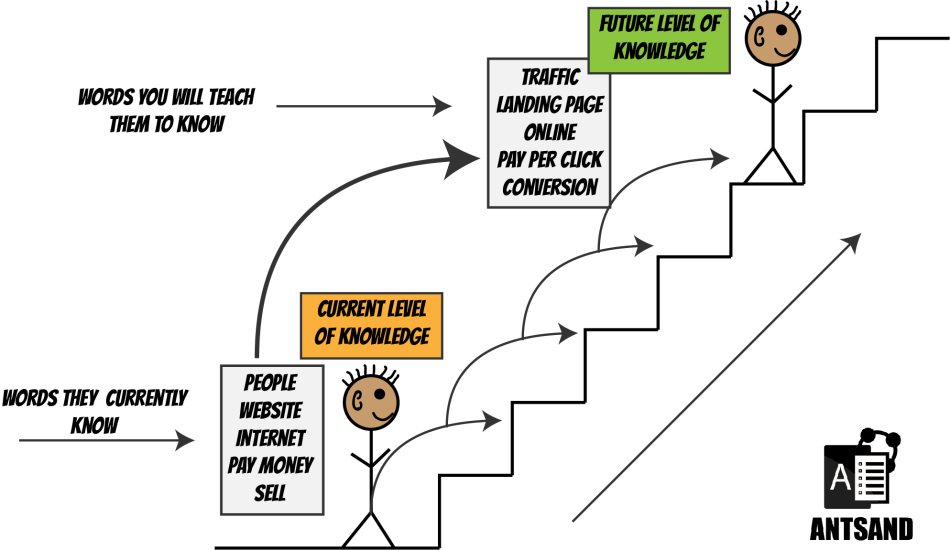
Take you readers by their hand and move them up the knowledge ladder step by step. Keep it simple. It will keep them engaged. As Einstein once said, 'Keep it simple but not simpler'.
Once you know how to bridge the gap, you need to allow your readers to think about the subject from different angles. Give them perspective.
Mental models:
Mental models are model you can apply to make better decisions. It helps you see an idea from different perspective using mental tool kit. With mental models, you start to ask better questions, and you are able to answer them in your blog post. The more questions you can answer, the more comprehensive it will be. You content will start to build trust with your audience and you will be able to position yourself as an authority. For e.g., if I want to convince you to write blogs, I need to give you perspective. I need to ask different types of questions as if I am the reader.
Mental models are a great way to outline your blog. It helps you plan, whom are you writing for (type of reader) and what kind of content would you like to share in your post. Mental models are great tools to brainstorm on ideas and get right into the minds of your readers.
There are various mental models. Below are few of the models I apply when I write a blog post.
2nd order and third order consequences
If you want to give your readers not only the immediate result, but the result of the result as well, you need to write about the 2nd order and third order consequences. It is similar to a snowball effect. for e.g if I am writing a blog on blogging, like I am in this article, to get my readers to think about how blogging can impact their life and business, I need to answer such questions,
What will blogging do to my business in 1 year, 2 years and 5 years?
How will I know it will work?
What if it does not work?
What impact will it make to my business?
How long will it take for my blog to rank on search engines?
Will it bring more people to my website?
What results can I expect after blogging?
What if I do not blog, what impact will it have on my business?
What skills will I acquire when I blog, and are these skills transferable?
Similarly, when you are writing or brainstorming on your blog content, ask questions and answer it based on the 2nd and third order result.
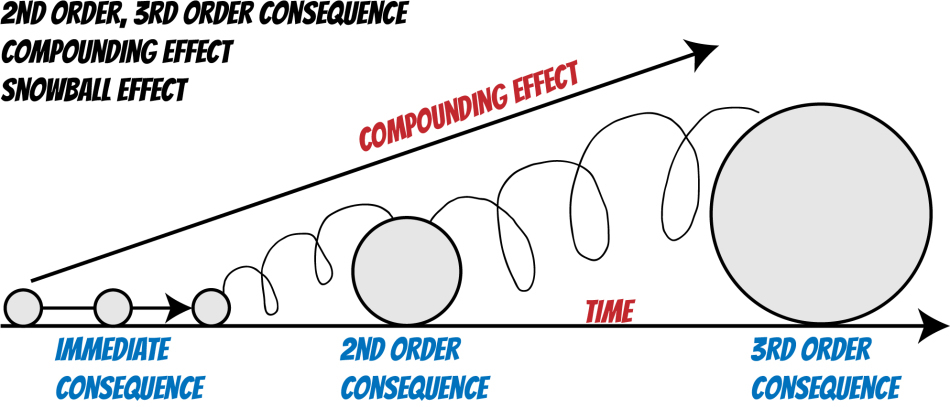
If you are teaching algebra and arithmetic, perhaps you can give your readers an idea of how important this subject is:
What practical application does arithmetic and algebra have? (create spacecraft, aeroplanes, trains, buildings, etc)
How can they become successful in their life?
How they can make this subject so much more fun to learn?
How can they practically apply this knowledge?
You see where I am going. Ask questions, so that you can make your blog more colorful to the reader. Give them hope, grow their aspiration, their imagination, their fantasies. Give them ways they can avoid their pain, their frustration, their headache's. You can paint such a picture, by giving them the 2nd order and third order consequence.
Occam's Razor: The simplest solution is the right solution.
Another mental model is Occam's Razor. Most often, your readers have come to read your blog to get a simple answer. Answer the simple question.
For e.g.
How to blog?
How to write blogs?
How to be a good writer?
How can I make money from my blog?
How should I start to blog?
When is a good time to blog?
How frequently should I blog?
These are simple questions. And I bet, most reader reading this blog is looking for these simple answers. Do not underestimate the power of simplicity.
Another model to apply is,
Hanlon's Razor:
If some one has made a mistake or done some harm it is due to their negligence and stupidity. Not because of their deliberate actions. How can you apply this model?
The way I apply this model, is if I want to talk about my stupidity and mistakes. This way, I am criticizing the process and my negligence, making my self vulnerable. For e.g.
Have you ever written a blog post, and offended a group of people?
Have you ever written a blog which was so polarizing, you started to get hate mails?
This is a model, one might use sparingly, but nevertheless, it is a powerful model to relate to readers that are at a low point in their life.
First Principles thinking:
This is a very powerful model. It can be applied in every context. It allows your reader to think from basic first principles, rather than from analogy. Let me give you an example. In case of blogging, what would first principles tell you.
The purpose of writing a blog is to make the reader read the full article, feel enlightened and engaged and possibly take some relevant action. To make the reader read the full article, you need to make the reader read every paragraph. Every paragraph consists of sentences, and you want your reader to read every sentence. Every sentence thus must be engaging. Only if every sentence is engaging, will the reader be compelled to read the following sentence. To make the sentence engaging, the sentence must be short, simple and easy to understand. The sentence must be made up of simple but powerful words that engages the reader. Therefore a good blog is nothing but a sequence of powerful and engaging words assembled to form simple sentences and paragraphs that enlighten and engage the reader.
If we have to reason this by analogy, you will end up asking irrelevant questions such as, should you write a long article or short article? Should it be on WordPress or some other blogging platform. Such questions, do not compel the reader to read a blog. But yet, we make most of our decisions based on analogy rather than reason from first principles. This is a major blind spot for most people. They argue and focus more on the tools and higher level abstract reasons, when in reality they should be focusing on how to write written words that captivate your audience.
When you write a blog, give compelling reasons that helps your readers think powerfully for themselves. Most blogs, are filled with tactics and ideas, but such tactics are time bounded. In the sense they are only relevant for a year or two at most. If you want to write evergreen content, content that will last for years to come, reasoning by first principles will never let you down.
First principles is just a thinking tool. There is not right or wrong answer. It helps you reason out things, and will help you clarify complex concepts your readers might have a hard time understanding.
Inversion:
Inversion is another powerful tool, to help your reader think from a completely different perspective. For e.g. If I tell you, if you write a blog on a particular topic, you might get thousands of visitors and a first-page result. That is a tempting promise, but no one can guarantee it.
Inversion, will tell you, what if I write this particular blog post and it does not get so many visitors and not rank on Google. How can I make sure things will not go wrong? When you invert an idea, you stop to have wishful thinking, and you suddenly start to create systems to prevent your ideas from going wrong.
When you write a blog, make sure you give your readers both perspectives. Do's and Don'ts. this way, you are covering a topic from all different angles making your post very very comprehensive.
You may not have to apply all these model in your blog, but they give you a great psychological framework to think about your blog. If you try to answer a large set of questions, it give your readers the power to view your blog from different perspectives and from different lenses. It helps you seek answers to questions you might not know, thus making your blog very comprehensive.
The power of 'YOU'
Moving on to the next content psychology and the most powerful word in the English dictionary. YOU. Your blog must talk to one person and only one person. Do not write in third person, do not write to a group of people or audience, but write to a single individual. We humans like to feel special. We all think we are unique and different. Make sure your blog amplifies this irrational behaviors of ours. The word 'YOU' does it for you. Just by stating 'you', we feel as if this blog is only meant for me and the author is talking to me. Nothing but me, only me, and everything is about me. You want your readers to feel selfish. Make them feel special.
By just using the word 'you' and talking to just one individual, your blog engagement will drastically go up. That is how powerful we humans feel, when someone is only talking to me. The secret is to make your reader feel special and make them feel as if you are talking only with them and no one else.
A long piece can still hold attention
This is a big one. Have you ever read a big book like Harry Potter or Lord of the Rings? Have you ever binge watched a T.V serial for hours and hours if not days? OR played a video game that made you sit on the chair for hours. You only got up because you needed to use the washroom. Clearly, if something is engaging enough, you can focus your attention on one thing for a very very long time.
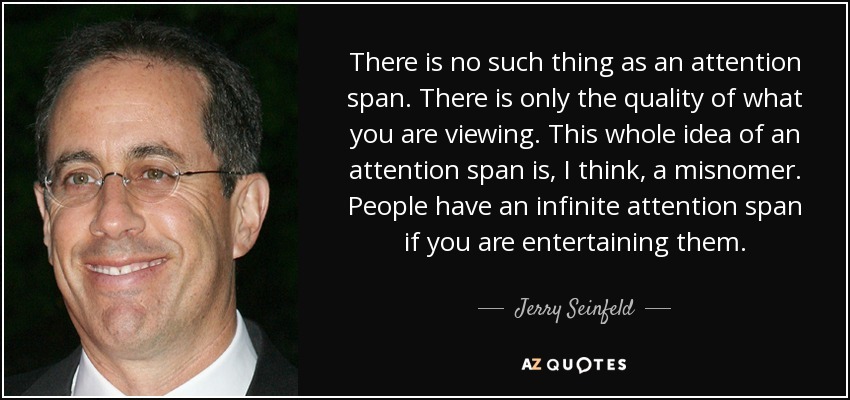
Your job is to make your blogs very engaging. Attention is limited, but there is no single magic number of seconds. You do not have only xyz seconds to capture and tell your message. Your blog can be long or short. What matters is whether each section earns the reader's time.
Make them read the next sentence
What is the purpose of a headline? What is the purpose of the sub headline? What is the purpose of the third headline? Every sentence has one job and only one job. To make your readers read the next sentence. I am repeating this again and again, because this is such an elementary concept, Most writers try to be creative and thus come up with creative headlines, that do not compel the readers to read the next sentence.
Four questions your reader may ask
I used to describe these as four learning styles. That sounds more fixed than the evidence allows. I now use them as four questions to check whether a draft meets the reader where they are.
Why should I care? What is the idea? How do I use it? What if I change the conditions? A reader may ask all four while working through one article. You do not need to label their personality. You need to give them a reason, a clear explanation, an example, and room to explore.
Walt Disney story line:
The best way to engage with your readers is by telling them a story. We humans learn better from stories rather than from facts and figures. Express your personal story, your learning experience, how you went from rags to riches and everything in between. Think of it like a Walt Disney story line.

Stories are important because the reader starts to see themselves in that story. They start to imagine being the hero/heroine of the story. You want to plot your character and story where there is a struggling part and a trans formative part. There has to be some form of emotional roller-coaster. It helps you to connect with your reader at a much deeper and emotional level. Stories can keep your readers engaged. It can move them, aspire and inspire them, motivate them, give them meaning and hope.
Concluding content psychology
In this section, we spoke on the different way to influence the psychology of your readers. From 'bridging the gap', to applying models that can help you write your blog using different perspectives, to using the most important word in the English dictionary, attention span myth and sharing stories. The goal of your content is to keep your readers engaged and take action.
We now move on to the next part of content, content strategies.
Content Strategies:
In this section, we will now focus more on the strategies. We will talk about, how to position your brand, how to write blogs for you to convert those readers to customers, how to grow your list, and how to write your blog to a particular set of audience. We will even touch base on the type of blogs you can write, 'How to guides', 'Ultimate guides', education, sharing your experience, stories, etc. Let us get started.
a. Positioning and influence
According to Cialdini, in the book Influence, he talk about the 6 ways in which you can influence someone. You as a blogger, need to position yourself as an authority. A subject matter expert in a given field. It is a huge form of influence.
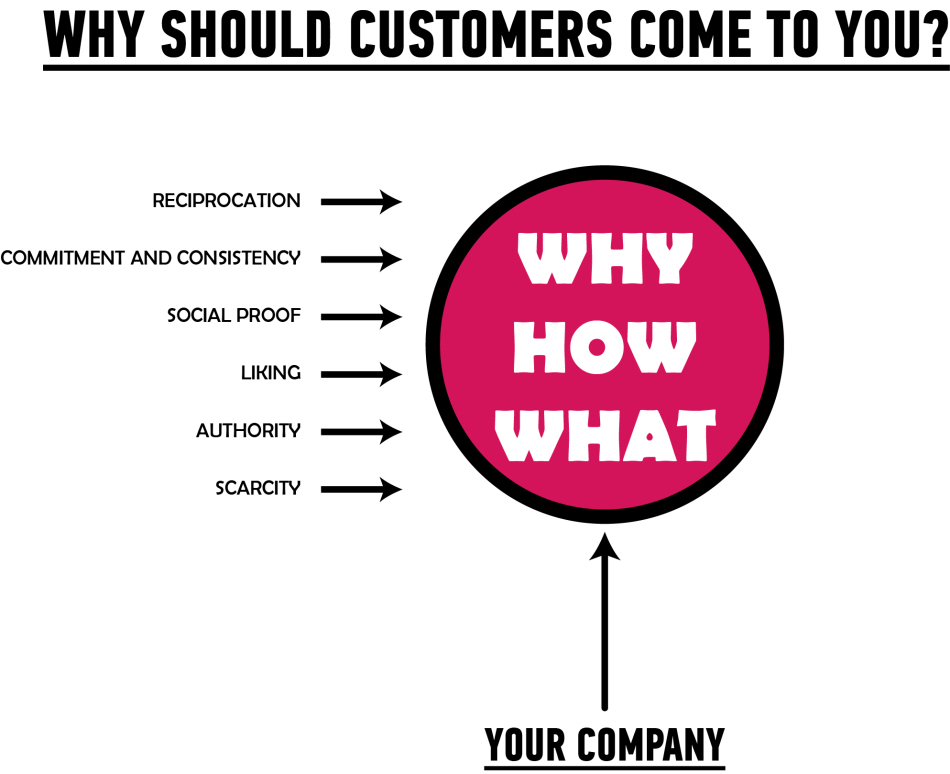
There are various ways in which you can position yourself as an expert. You can be a curator, where you research from other people's work and write about it. OR You personally might be an expert or a practitioner on a given subject and you want to blog about your expertise. OR You could position yourself as an educator, and teach others your understanding of a subject. Or you can be a researcher, where you conduct your own experiments and observations and write a blog on it. You can even blog on an experience you had and what you learned from it.
There are numerous ways in which you can blog. But to be a great blogger, pick one or two ways in which you want to be an expert and an authority and position yourself quickly. Either, choose to be a curator and an educator. Or choose to be a practitioner, and write about your expertise.
- Curator e.g. Wait but why, Malcolm Gladwell
- Researcher e.g.
- Practitioner / Expert e.g. Many company blogs, talking about their products and applications - Trello, Asana
- Experimenter and observational e.g. Seth Godin
- Experiential -> Travel bloggers
Once you have an idea, on the type of blogger you are or you want to be, you want to figure out ways in which you can assemble your content and ideas.
b. Written Blog types:
There are various types of blogs you can write on. If you are writing a comprehensive blog, 'Ultimate Guides' like this blog is a good way to build authority quickly. You need to take the time to research and write a good blog. But, the time is totally worth it. Let me list a few types of blogs you can start to write on.
Ultimate guides - Great way to position yourself as an authority. Must be very comprehensive. Must be easy to follow. Will take time to complete it, but it should not stop you from writing ultimate guides.
Marketing Made Easy - Ultimate guide to making your business more marketable and profitable
Education and quizzes - If you are teaching a subject to a select few target audience, educating them and asking them to answer quizzes is another great way to build and position yourself as an authority.
e.g. Big History Project, Khan Academy, Coursera, edX, Udacity
How to guides - How to guides are great blog post, if your reader is looking for a very short but specific solution. They might be looking for a recipe on how to cook something, or how to use a piece of equipment, or how to fix a problem with their computer. How to guides are short and to the point. If your how-to guide is able to give the reader the most efficient and effective solution, they will soon start to trust your brand and advice. Once again positioning you as an authority.
How to guides are very specific to a target audience and they are specifically looking for a solution. Not everyone is supposed to understand to read them.
Here are my examples.
How to integrate php and vue.js components
Integrating, php, vue and webpack with code examples
Creating restful APIs using php and vue
Top 10 list - New articles and many other blogs are great at comping up with their own Top-(number) list. It catches people's attention. We all want to know the top -10 trends, the top 10 richest people, the top 10 crazy families, the top 10 expensive houses.
Similarly, in your field of expertise, what is it that you can talk about, that you can put in point form. Here are my examples:
8 steps to create world class UI and UX for your startup
12 mindsets and behaviors required for running a lean startup
12 ways to maintain your website and increase sales
39+ mental tools I use to make better decisions
13 things I learnt after doing the 10 week wim-hof method
Experience and what you learnt - Experience is all about writing about your experience, ideas, passion your life and reflection. It is a great way to show your human side and share your story. I tend to write about my experience in a point format like the -Top-10 list. But, you can write it in any shape or form.
For e.g.
13 things I learnt after doing the 10 week wim-hof method
Random, fillers - Sometimes you need to write a blog, so you just get out your notepad and start writing. You write a bit on some ideas, your outlook in life, your opinion, your strategy. It still makes sense, but it is random. It is great to send it to your email list, but it may not answer a common search query. That does not make it worthless to the people already following you. A great example of such a blog is Seth Godin. He writes well, and shares his opinions. Keeps his blogs, short and sweet.
Challenges - Challenges are a great way to get started writing blog post. You can have a 30 day challenge on your diet plan, starting a business, forming a new habit or blogging everyday. All you need to do is blog about your challenge. You can use you blog as a reflection medium or a planning medium. Once you blog about it, you can ask friends and family to support you. Over time, strangers too will be able to see and relate to your challenges. If they too are planning on undergoing such challenges, they will use your blog as an inspiration.
You can write on 1 week challenge and blog every day, 30 days challenge and blog every day or once in 2 days, 1 month challenge or 3 months challenge. Find a rhythm, and blog periodically. It helps you to become consistent and make progress faster.
To get the most out of any challenges, you need to set a plan and do daily or immediate reflection. Use blogging as the medium to plan and reflect.
Stories - Stories are a great way to share your life, your experience and your opinions. People like to read and hear other people's stories. They remind us of ourselves, if they relate to it. You can write about, how broke you were when you started a business and how you made it all work, or how you went snow boarding for the very first time, or how you enjoyed eating sushi for the very first time, but hated it. Stories allows you to open up, and connect with other people. It is a great way to start blogging.
A good blog over time in general must have all of the above categories. It will give your blog a flavor, make it colorful, give it a personality and position your brand not only as an authority, but will also build likability and social proof.
Case Studies - Case studies are a great way to build authority. You basically are taking a concept, idea or work of others and making a case out of it. You can define what you want your case study to be about. In our case, we were trying to evaluate others websites. What they did right and what they could do to improve.
E.g :
Property maintenance case study
Fictitious Stories based on real life examples - Sometimes you cannot write anything about your practice or clients because of confidentiality reasons. But, you do know that the problems they all face are common. Nothing is unique just specific to that particular client. Writing a blog based on a fictitious character but based on true events can build your credibility. This way you are positioning yourself as an authority and yet not revealing your clients.
Tactical vs Strategical - Tactical blogs are blogs that are temporary but important. For e.g. Writing a blog on 'The top 10 blogging tools to use in 2019'. This is a tactical blog. In 2022 this blog would be irrelevant. Perhaps you can keep updating it, but it is time bounded. Strategical blogs are blogs that will stand the test of time. For example "Marketing made easy". That blog will last for ever till human psychology completely changes. Perhaps even this blog is very strategical. After 5 or 10 years most of this blog will still be relevant. At least, I like to believe so.
So know what type of blog you are writing. Is it a long term or short term, is it tactical or strategical and accordingly plan.
c. Modalities of blogging
There are different ways in which you can communicate your ideas and stories. Using today's medium, there are primarily 4 main types.
Written content, Video blogging, Podcasting, Images, pictures and infographics
Written content- This is a great example of written content. Writing takes time, resources, patience and energy. It also gives readers a page they can search, quote, and return to.
Audio and podcasting - If writing is not for you, but you still want to have a written blog, talk to a mic and transcribe it. There are many blogs, where the author just talks to you in a mic and they transcribe it. This way, they can relate to both types of audience. Those who like to read and those you like to listen.
Video blog - Not every one likes to write or wants to write. You might be a great person in front of the camera. You might just want to do video blogs or as they call it vlogs. There are so many YouTube celebrities that make a living just doing video blogs. I reckon you shoot your video, upload it on YouTube and share that video on your blog. Write a brief description of what the video is about and now you have an embedded video in your blog.
Images, Pictures and Infographics - Another great way to share content and build engagement and authority is by using pictures, images and infographics. Instagram is a great tool to help you connect with your audience visually. If you are the visual and picture type write a small brief description of what the image is about and that is a form of your content. You can integrate Instagram on to your blog, or perhaps you do not need to. But write a small description related to the picture. Associating some text with your image will give context, meaning and position you as a blogger. You do not just want to take random pictures and spam peoples news feed. Give context and meaning.
d. Branding
When it comes to writing content and content marketing, you are basically using it as a form of branding. Branding is nothing more than how a reader or an audience or your clients and customers view you and your company from an emotional lens. Let me explain.
What do you feel and hear when I say the word Walt Disney?
What do you feel and hear when I say the word Apple?
What do you feel and hear when I say the word Nike? or Coca-Cola or Mercedes Benz or a Tesla?
There is an emotional feeling and sensation you have when you hear those brand names. Your job is to find out, what your reader and customers should feel when they read your blog.
Some of the emotions you can associate with the above brands:
The most magical place on earth, status, luxury, happiness, just do it, athletic, style and class, prestige, power, hope, joy, love, enlightenment, entertainment.
How can you give your reader such an emotional feel? Not logical feel, but emotional feel. Can you inspire them, aspire them, give them hope, make them feel enlightened, give them courage, give them the power to become a better version of themselves, become a leader. Once you know, what emotions you want your readers to feel when they associate themselves with your brand, your job is to write content and position yourself or your brand accordingly.
Let say you want to position yourself as a motivator, educator and the most magical blog on the internet. What would you have to do? What would make your blog the most magical? How can you motivate your audience and yet give them a magical experience?
Can you see how by viewing your blog from the eye of your readers and how they feel, you now can start to shape your blog accordingly. Fascinate them, with your uniqueness, your knowledge, your art, your creativity, your innovation and your perspective.
To position your content and brand, add personality, be relatable, be friendly, motivate, teach and inspire. By using mental models as we spoke about earlier, by using the word 'YOU', and making you blog personal, by giving them stories that enlightens and entertains, you can position yourself and your brand emotionally in a good place in your readers and audience mind.
One exercise you can do to figure out your branding, is to create a customer avatar. I wrote about this in my previous blog on Marketing. A customer avatar is a fictional character that you create that resembles your ideal customer. When you try to position your brand to serve this customer avatar, you will be able to figure out what you need to do and why you are doing things. You start to understand their needs, their wants, their aspiration, their dreams and their problems.
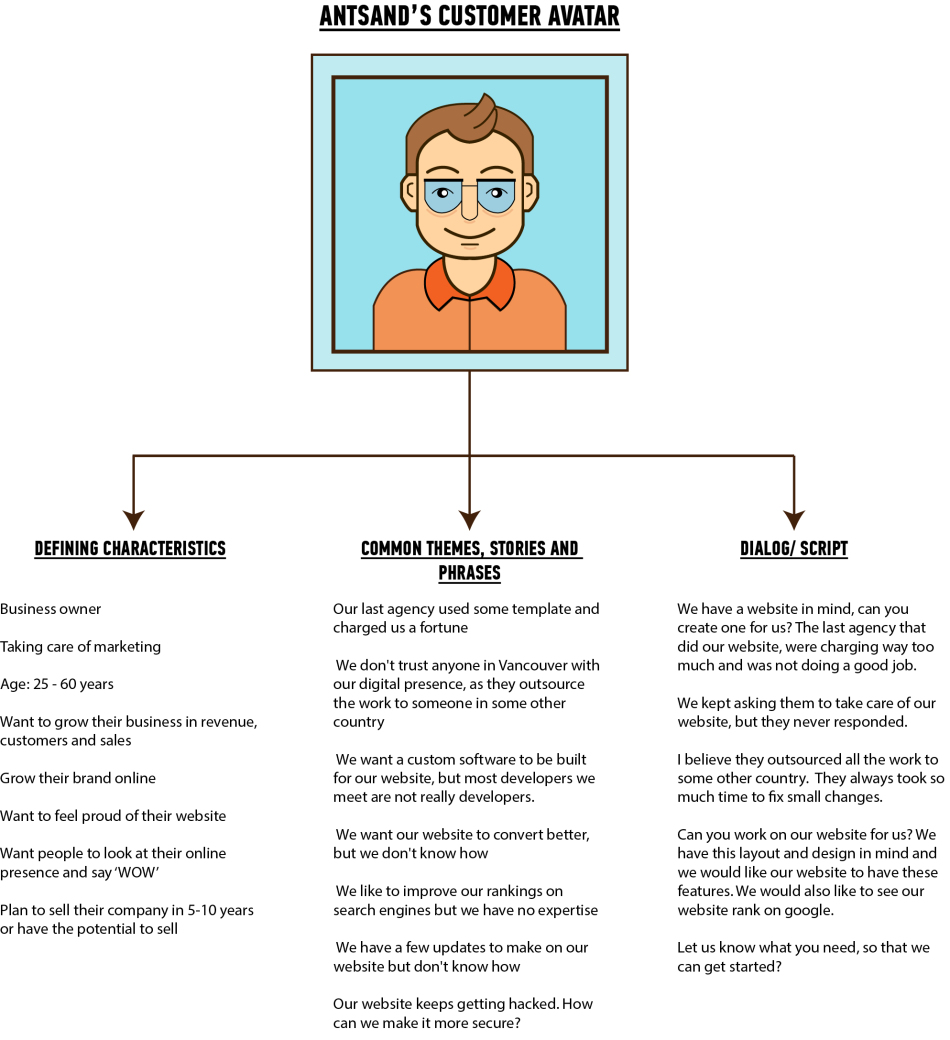
If you can position your brand in such a way that you can satisfy your customer avatars problems, you suddenly will start to feel like an expert. But I also suggest you follow your intuition. At the foremost, you still need to love writing and love what you write.
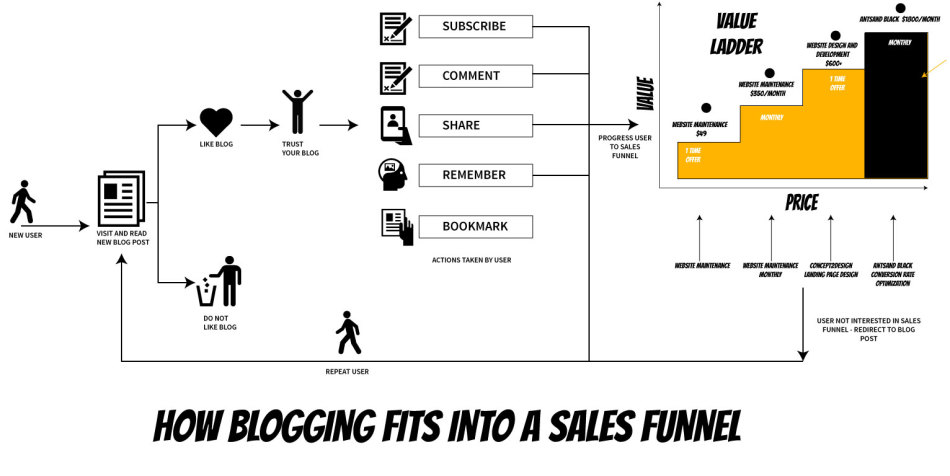
e. Value ladder
A blog must be an entry point for users and potential customers to visit you. It relies heavily on the influential principle 'reciprocity'. The more you give, the more you get. It is a powerful way to bait a customer to trust your brand, and convert them to customers without you being a pushy salesman.
f. List building
One way to grow your list, is to write great, effective and value added blogs. If your readers find your blog engaging, valuable and inspiring, they may want to read more from you. If they do, you can create a 'subscribe to my blog' form, giving your readers an option to connect with you more intimately. You can capture their email address, which now gives you access to contact them directly with their permission. The bottom line of creating a list is to first write great blogs. Without which, trying to grow a list will be a very daunting task.
g. Content marketing and SEO
Content marketing and search go together, but they are not the same thing. Search engine optimization (SEO) helps a page be found and understood. Content marketing asks what I can publish that is actually worth a reader's time. A page should answer the question the reader came with; a keyword alone cannot do that.
When I search for a topic and find weak or incomplete answers, I see an opportunity to explain it better. I look for the missing example, the confusing step, or the question no one answered. That is a useful way to choose a topic, not a guarantee that a search engine will rank my article above someone else's. I publish, check the page, and measure what actually happens.
Good content is worth making even when search traffic is uncertain. Clear structure, accessible links, and a page that actually answers a reader's question help people use it. Search visibility may follow, but it is not a prize that the article alone can guarantee.
h. Social media marketing
Social media marketing is a different beast. It is immediate gratification, immediate news and stories. It is analogous to a newspaper with the latest news of people life. Hence, it has to be constantly updated and new. A good strategy is to write great content and post snippets of that content on social media. This allows you to update your social media channel often, while also linking your social media post to your blog post. This gives you some back links and a new set of users who are more active on social media to visit your website.
Concluding content strategies:
This section has been filled with valuable information. We spoke on how to 'position your company through blogging' how to write different types of blogs, list building, branding, SEO and social media.
The end goal of these strategies, is to build a list and direct your list to your sales funnel. If you do not have anything to sell, you can keep writing great articles, grow your audience and sell when you have a product or seducer to offer.
Content Actions:
In this section, we will talk about the actions you can take immediately to get started in your blogging journey. We will talk about the things that can stop you from writing, and how to overcome those blocks, as well as how to stay motivated, and productive. We will also talk about how to plan your blog calendar, so that you have a strategy to follow. Let us get started.
a. Content writer's productivity hacks
When you start to write, you will face numerous challenges. Most of those challenges will be internal. You will end up asking, ;what should I write on', ' how to start', 'when to start', 'my English is not good', 'my writing sucks' etc. You will be asking yourself numerous questions that will stop you from taking action. The first thing I do when i write is 'write'. Just start writing. Do not expect it to be perfect. Write 'bla bla bla' if nothings comes to mind. Momentum is key to success. Which momentum everything feels natural and on steroids. Your goal is to build up momentum quickly. You can only build momentum by taking action. Not meditating. So start now. Use a pen and paper if need be.
Even J.K. Rowling, arguably the storyteller I admire, uses pen paper and word. Keep things simple. Use the necessary tools.But get started.
Pen, paper and then Microsoft Word 😏 https://t.co/zD2ImtRjFG
— J.K. Rowling (@jk_rowling) January 30, 2018
Do not break the chain rule
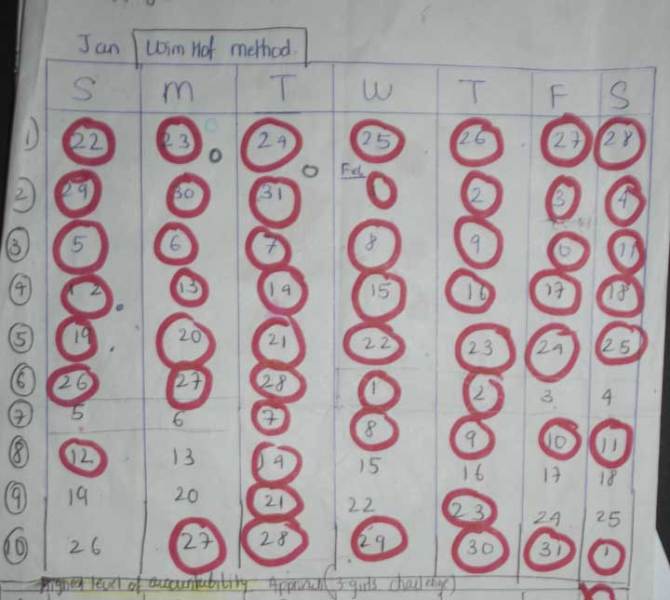
You need to write every day to build momentum. I use the great Jerry Seinfeld routine, do not break the chain.
Every day, after I write or do an activity or habit I am working on, I circle that date. Over time, this will form a chain and as a result, you would not want to break it. It is like a small game you play with yourself, but it also keeps you accountable.
Discipline and routine:
Without discipline and having a strong routine, you wont be able to produce great stuff. A routine is where do set up an activity that gets you in the zone to do your magic. Such as finding a desk to right on, and calling it your writing desk. Setting up the lights, the music or tools you need to get into your writing zone. Over time, it preps your mind that you are now going to write. J.K. Rowling had a routine. A routine which helped her write her Harry Potter books.The best writers all have a routine that helps them think clearly on what to write. It is a way of getting you in the zone.

The desk where J.K. Rowling finished writing Harry Potter and the Deathly Hallows.
Everything is a routine. If you set a desk to write, it is a good idea to make that desk your writing desk. I tend to,
- Sit on my desk - work desk -
- get a bottle of water
- keep a log
- open my ANTSAND dashboard
- And start blogging
- Every half hour or so, write my activity on my log book
With 'Don't break the chain rule' and having a steady steady routine, you will start to be an effective blogger.
Deep work
Writing is a cognitively demanding task. You will be exercising mind muscles that can drain more energy out of you compared to less cognitive task. Hence, make sure you remove yourself from activities that drains your cognitive power. Activities like social media, random internet surfing, arguing aimlessly with people, or doing shallow work. You want to keep you mind in a healthy condition, so it can use all it's energy and resources to help you write better.
A great book to learn more about deep work, is 'Deep Work' by Cal Newport. Highly recommend reading it. It has a great deal of valuable insights.
Deep Work by Cal Newport, published January 2016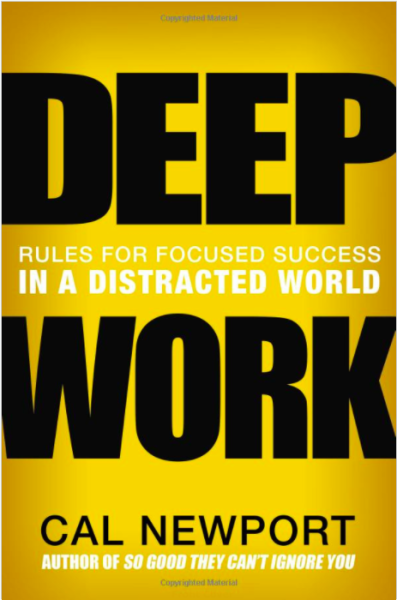
Time logs
I keep time logs to keep track of my activity in an half hourly basis. This helps me from stop getting distracted. Sometimes, I do not feel like working, but I tell my self, lets work for an additional half hour. It helps me push further, farther and be more productive.
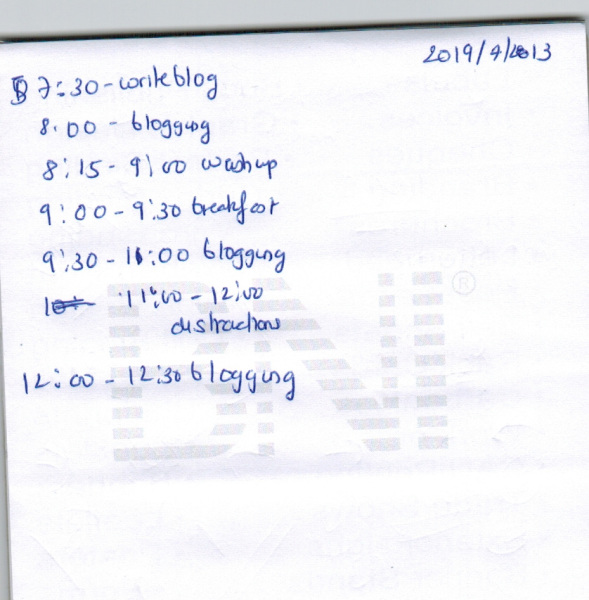
A Simple log to keep track of my hourly/ half-hourly activities
5 mins breaks
Take mini breaks, like drinking water, washroom breaks, stretching, excising. Keep the blood flowing, keep your body energized and keep your mind active to endure long work hours.
Writers block
If you get stuck on what to write, taking a break a good way to reorganize your thoughts. If you feel your mind is getting heavy, I tend to lie down, close my eyes and think over the problem. This allows me to stop my mind to reacting to any of my senses (light, taste, noise, touch, smell) and only focus on the problem in sight.
Another way to get over writer's block, is to continue writing rubbish. Just keep writing. Write 'bla bla bla' if you have to. But keep your fingers and mind moving. It will be a brief stint, but will help you get over your writer's block.
record your words and speeches
Not everyone is a writer. If you do not like writing, but like to talk, talk. Take a microphone using a phone or a dedicated devices and star recording your content on a microphone. After you finish recording your content, transcribe it, into written words, remove all the umm, huh and fillers. Polish it, clean the grammar errors and there you go. You have a blog. You don't have to write to blog. You can speak your blog out and transcribe it to written words. This strategy is very effective for those who do not like writing.
I do not practice this technique much, but I do know of many people who do this.
Practice what other have written to get their flair of the language
If you seriously suck at writing, you need to read. Read blogs, or articles that you like. Print those articles out, and start to write them with your writing. You want to absorb their flair of writing, their style their voice etc. Over time, with practice you will find your voice. At the beginning it is not a bad idea to get your voice from other great writers.
Conclusion
Once you have momentum, If you hit a creative/ idea block, go on the internet and find topics related to your blog post. Do not be afraid to write similar topics others have written on. The universe has plenty of room for multiple voices and perspectives on the same topic. Look at how many blogs are out there on marketing, blogging, cooking, fitness. Your voice and perspective is unique, and that is what is important.
b. Content calendar
To be a great blogger, you need to be consistent. You need to be producing content regularly to find your voice. Once you have a following, you can slow down and take time to write content periodically. If you are new, and you need to start getting a following and building your list, consistency will be your weapon. Below is a small little content calendar, I give this framework to all my clients, so that they have a map of what they plan to write every week. I suggest writing every week. Brainstorm on some topics, and keep writing the headline of your post for the next 10 weeks.
This is not written in stone. You can always change and modify it. But make sure you do this exercise, as it give you a map, a vision, and a plan. Without a plan, you could be aiming in the dark. Most blogs do not succeed, primarily because they are not consistent. Be consistent.
Content Calendar
Week 1. The headline or title of my post could be:
Week 2. The headline or title of my post could be:
Week 3. The headline or title of my post could be:
Week 4. The headline or title of my post could be:
Week 5. The headline or title of my post could be:
Week 6. The headline or title of my post could be:
Week 7. The headline or title of my post could be:
Week 8. The headline or title of my post could be:
Week 9. The headline or title of my post could be:
Week 10. The headline or title of my post could be:
c. Content flow - How to assemble and curate your content?
This section on blogging action, we will go deeper into how to organize your content. Copywriting techniques, headline techniques, words to use, and tools that can help you.
There are many resources on copywriting. In its simplest form, Copywriting is the art to write written words that compels the user to take necessary action. It has many components to it. Let us dive into few techniques that can help you get your copywriting skills to the next level.
AIDA-
Attention - First get the readers' attention
Interest - Second, get the reader interested
Desire - Third, make them desire what you are writing about
Action - Compel the reader to take whatever action is needed to get whatever it is you are selling.
Let me explain each of these four formula elements in detail.
Attention comes first. Naturally, you should get your readers' attention before your readers become interested in the article and consider your offer. Getting attention is CRUCIAL. If you do not get the readers' attention, readers may leave before seeing the work you put into it. That is why at ANTSAND, we focus on making the blog different, look good, load fast, filled with pictures, keep the blog clean and make the blog very friendly to read. Together, these choices help readers stay with the page. A great headline is also an attention grabber.
You must get the right kind of attention. If your headline grabs the users attention, but your blog article is irrelevant to the headline, your reader will be insulted and angry and probably will never trust your blog. So always remember that your attention grabber needs to be relevant. It needs to tie in naturally to your blog.
Next, we need to make the reader interested. You can make your blog readers interested by showing them results they will get if they read your blog. The results you promise in your blog, should be results your readers want. This is one way to get them interested. Another way to grab your users interest, is to build curiosity and tell the readers how you plan to answer such curiosity. Curiosity gets
Desire - To arouse the desire of your readers, your blog must describe benefits, results, aspiration, motivation, stimulate your readers intellectually and give them a reason to believe your blog. Mention resources used to prove a point and why you believe it will help your readers. Make them want to trust you, like you, love you, feel engaged and put your on a pedestal.
Action - Finally, make your blog action driven. Give your readers an option to take action when they finished reading your blog. Be it to subscribe to your blogs, post a comment, share your blog or take them to your sales funnel.
ANTSAND Formula
Another formula we use at ANTSAND which is similar to AIDA
A - Attention - Grab their attention
PD - Problem definition - Define the problem your blog is trying to solve
AAS - Amazing Attainable Solution - Give the best solution to the problem
PC - Proof and Credibility- Prove why your solution is the solution your readers must trust
CTA - Call to Action - Give them an action to take after reading your blog
In the attention phase, the ANTSAND formula comprises of 3 main questions
- What pain points does this blog address. Describe who are the actual audience for this blog
- Then describe how this blog will be structured
- Then mention what is blog is not about and what you certainly will not get from the blog.
In the problem definition phase, the ANTSAND formula comprises of 3 main components
- Why do you have this problem. Let us first shift your mindset
- What is the psychology behind having those critical mindsets to help you get out of your pain
- What actions you can take to help improve your psychology and the results you are looking for
d. Ways of explaining your concepts -
There are various ways in which you can curate your blog. you can add
- visually - infographics, pictures,
- story, - personal stories or curated stories from other
- experience - personal experience your other experience to prove a point
- links, audio, video
- written content
e. Types of headlines
Giving a headline to your blog, is very important. It must grab people's attention. Or else no one would read your blog. It is an entry point to your blog. The best headlines are those written in magazines and advertisements. Keep a swipe file of headlines that you find interesting. A swipe file is a file/folder of interesting articles you find and you believe you can learn from or use them for your own material.
Some tips on writing headlines -
- Numbers - having numbers in your headlines is a great grabber. E.g. 12 mindset and behaviors required for running a lean startup
- Questions - Asking a question in your blog headline is another great attention grabber. E.g. How to learn how to write software?
- Guides - Having the word 'Guides' in your headlines is a good attention grabber. E.g Marketing made easy - Ultimate guide to making your business more marketable and profitable
- 101 - Having the word 101, is a nice way to give the impression as if you are having a 1 to 1 with a reader - E.g Marketing 101
- Dummies - If you are writing a blog for the layman, having the word 'dummies' is a good attention grabber
f. Tools to use:
The tools I use to write blogs is no more different from what J.K. Rowling used. Keep your tools simple. Do not get caught up in the tools. Focus your energy on what you want to write on, how you want to say it, what will keep your readers engaged and what will make them want more from you.
As far as tools goes, these are my tools: Pen, paper, eraser, notepad, drawing book, blog editor, internet
Putting it all together
I wanted this guide to give you a way to move from an idea to a finished article: understand the reader, choose a useful angle, gather examples, write a draft, and check whether it answers the question you started with. I still use that sequence. I also revise old posts when the facts, links, or my own thinking change. If you made it this far, pick one idea and try it in the next thing you write.
Conclusion:
If you have a question or tried one of these ideas, tell me what happened. At Antsand I write from my own attempts, including the ones that failed. I would rather talk through a real draft with you than pretend every tactic works every time.
If something here helped, tell me which part you used and what did not work. I would rather hear about a real draft or a real publishing problem than pretend there is a magic formula. The old $5 marketing-package idea mentioned in earlier versions of this post was never a current offer, so I have removed that invitation.
If you want to read other blogs that might interest you, have a look below.
Sources and further reading
- Library of Congress: the Gutenberg Bible for the printing history.
- CERN: a short history of the Web for the Web timeline.
- Google Search Central: people-first content for current guidance on usefulness rather than ranking tricks.
- Google Search Central: link best practices for links readers and crawlers can follow.
- My content-roadmap article for planning a connected set of posts.
More Stuff from ANTSAND
Business, UI and UX:
Speed of Implementation for UI and UX startups
8 steps to create world class UI and UX for your startup
12 mindsets and behaviors required for running a lean startup
12 ways to maintain your website and increase sales
My mental maps for success:
39+ mental tools I use to make better decisions
If you are a programmer, you can read more on our Programming blogs:
How to integrate php and vue.js components
Integrating, php, vue and webpack with code examples
Creating restful APIs using php and vue